There’s a moment just before you stand up to deliver a wedding speech where the room suddenly feels very quiet.
You can hear cutlery settle. You become aware of everyone looking in your direction. And somewhere in your peripheral vision, there’s a camera.
If you’re the groom, best man or father of the bride, this is completely normal. Even confident public speakers feel the pressure at weddings. It’s personal. It matters. And when there’s a videographer in the room, you naturally want to get it right.
Here’s the good news: being filmed doesn’t make delivering a wedding speech harder. It simply means a few small practical details matter a bit more. With the right preparation, you can look relaxed, sound clear, and help create something the couple will treasure for decades.
This guide isn’t about how to write a wedding speech – there are plenty of those already. This is about how to deliver one confidently when a videographer is capturing every word, every smile, and every emotion.
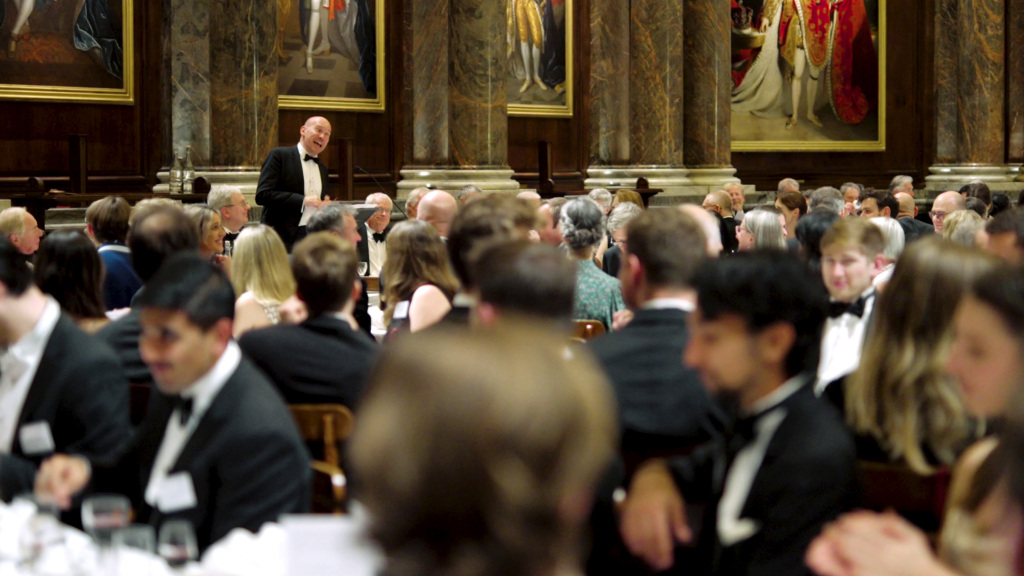
Speech to over 400 guests at Drapers Hall, London
Rehearse Properly (Not Just in Your Head)
If there’s one thing that genuinely transforms how a wedding speech looks on film, it’s rehearsal. Proper rehearsal.
You don’t need to memorise every word. But you should know it well enough that you can look up regularly, make eye contact with the couple, smile naturally, and recover smoothly if you lose your place.
When you read word for word from a sheet of paper, constantly looking down, it changes how you come across. From the audience’s perspective, it feels less connected. On camera, it can genuinely look as though your eyes are closed for long stretches. And film captures faces – your expression is what carries the emotion. If we can’t see your face clearly, the impact reduces.
So practise out loud. Stand up while you’re doing it. Time yourself. Delivering a speech to a room full of people feels very different to quietly reading it at your desk.
Use Prompt Cards, Not A4 Paper
This sounds like a tiny detail. It’s honestly not.
Full sheets of paper often rustle. If they’re inside plastic sleeves (which some people use to protect them), the noise gets amplified. And because speakers naturally hold paper close to the microphone, every movement can be picked up clearly.
Prompt (or flash) cards are far better. They’re quieter, easier to handle, less visually intrusive, and simpler to glance at discreetly.
Keep Them Low
Here’s another small but important tip: hold your cards below chest height where possible.
In many venues, your videographer may need to crouch slightly to avoid blocking guests’ views. If your prompt cards are held high, they can partially block your face from the camera’s angle. Lower cards mean a clear face, which means better footage. It’s a simple adjustment that makes a noticeable difference in your wedding film.
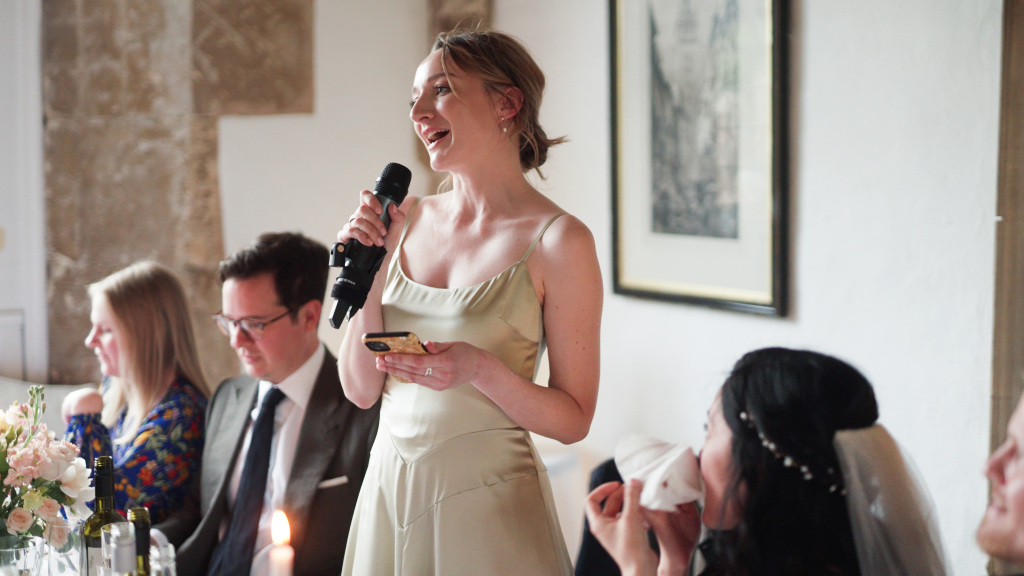
Maid of Honour speech notes on a smartphone and kept low (Butley Priory)
Talk to Your Videographer Before You Start
One of the easiest ways to ensure your speech is captured perfectly is to have a quick word with the videographer beforehand.
Before you begin, just check:
- Do you need to be mic’d up?
- Is there a particular cue to start?
Between speeches, cameras are often repositioned and audio may need adjusting. If you start speaking while equipment is still being set up, those opening lines might not make it into the final film.
And if you’re planning to do anything a bit different (walk around the room, use props, invite someone to stand, play a surprise video, or move away from the main table) let the videographer know in advance. It allows them to prepare properly and avoid scrambling mid-speech.
Good wedding videography is about anticipation. Help us anticipate, and we’ll make you look brilliant.
Where to Stand (It Matters More Than You Think)
Lighting and background are two of the most overlooked parts of delivering a wedding speech, but they make an enormous difference on camera.
Avoid Standing in Front of a Bright Window
If you stand directly in front of a strong light source, especially a large window during daylight, you can become a silhouette. Cameras expose for the brightest part of the frame, which often means your face becomes darker than it should be.
Ideally, light should be coming from the side or in front of you. This ensures your expressions are clearly visible and you don’t disappear into shadow.
Choose a Good Backdrop
A textured wall, a floral installation, a fireplace, or part of the room with a bit of depth looks far better on film than a plain white wall.
Before guests sit down, it’s worth having a quick conversation with your videographer and venue team about where the best place is to stand. Two minutes of planning can genuinely transform how the speeches look in the final wedding video.
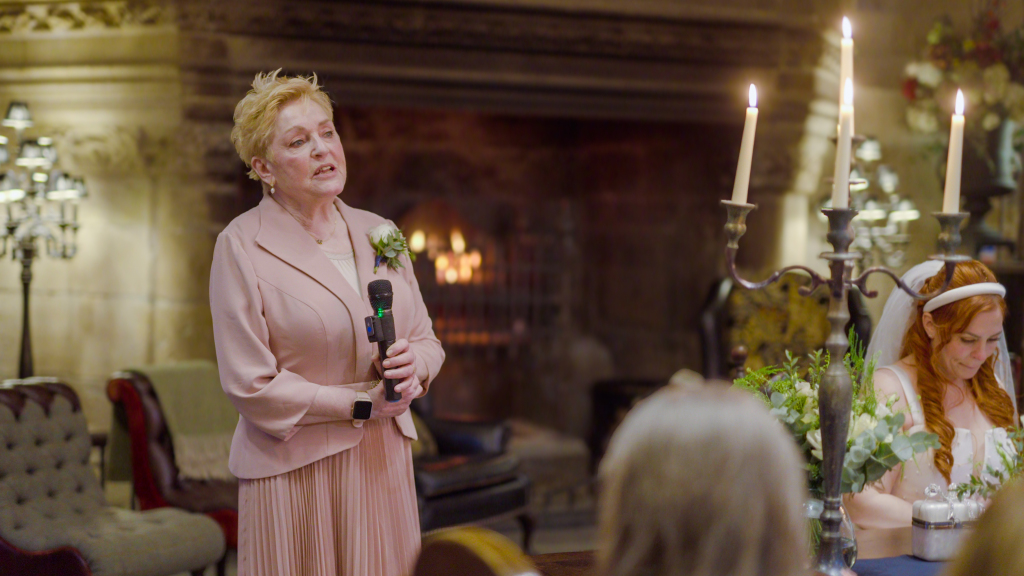
The perfect backdrop for speeches at Borthwick Castle near Edinburgh
Should You Look at the Camera?
Short answer: no.
This is one of the most common questions people ask, and it feels counterintuitive when you know you’re being filmed. But the reality is, your speech isn’t for the camera – it’s for the people in the room, especially the couple.
Speak to your audience. Make eye contact with the bride and groom. Glance around at the guests. Let the camera observe you doing what you’d naturally do. When speakers stare directly into the lens, it can feel oddly formal and disconnected, almost like a news broadcast rather than a heartfelt moment.
The videographer’s job is to capture you being present with the people you’re speaking to. Trust them to do that. You just focus on connecting with the room.
When Should Wedding Speeches Happen?
From a filming and atmosphere perspective, wedding speeches are almost always best before the meal.
We’ve written a full guide explaining why this works so well (see: How to Plan Your Wedding Day Timeline for the Best Wedding Film), but in short: guests are more attentive, there’s less background noise, energy levels are higher, and there are no plates clattering or waiting staff moving through the frame.
If speeches take place between courses or after dessert, it’s worth asking the catering team to pause service entirely while you’re speaking. Staff walking in front of cameras and cutlery noise can be genuinely distracting and difficult to remove in post-production.
If you’re planning your wedding timeline, it’s worth reading our full article on why speeches before the meal tend to work best.
Wedding Speech Audio: What You Need to Know
When a wedding speech is being filmed, audio quality matters more than anything else. Beautiful visuals simply cannot rescue poor sound.
Using the Venue or DJ Microphone
Many venues provide a handheld microphone connected to their sound system. Often, your videographer can take a direct feed from that system, meaning we capture exactly what the room hears. This avoids having to place a separate lapel microphone to every speaker.
However, this isn’t always possible. Some venues have sound equipment that’s tucked away or inaccessible. We recently filmed a wedding where the entire sound desk was located in a loft space. There was simply no easy way to take a feed.
That’s why experienced wedding videographers prepare for multiple scenarios.
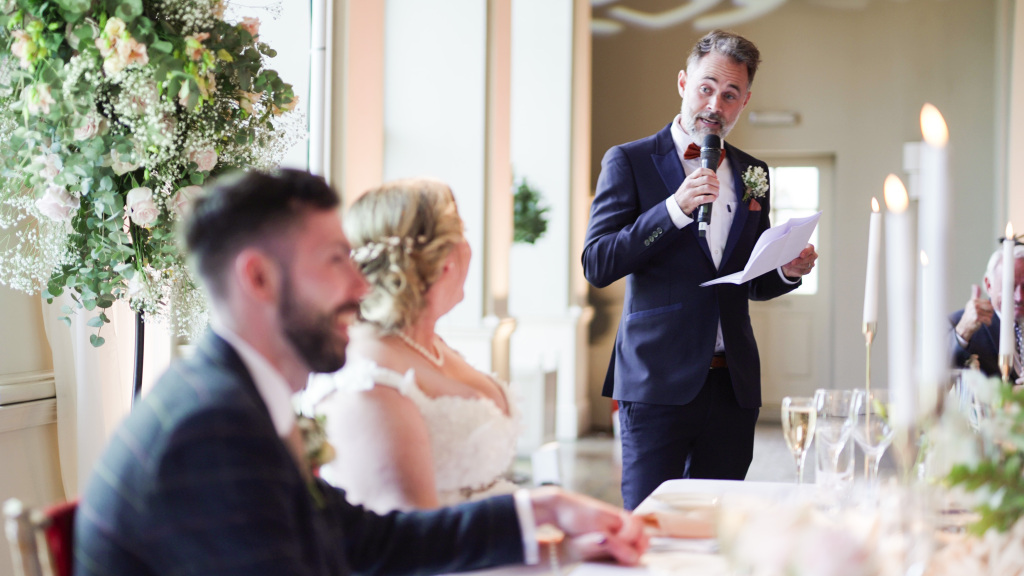
Wedding speech at Stubton Hall being delivered confidently
Why Two Audio Sources Are Best
Professional videographers typically aim to record at least two audio sources per speaker. Why? Because things can go wrong. Microphones can fail. Batteries can run out. Someone may accidentally switch something off.
At Momentous Films, we record using 32-bit float audio, which means we don’t need to worry about traditional level setting and can recover from unexpected volume spikes. Not all equipment works this way, so some videographers set different backup levels for safety in case one speaker is significantly louder than another.
To cover most situations, we carry discreet lapel microphones, small recorders that attach directly to venue microphones, and portable recorders that plug into a venue sound board. The goal is simple: clean, reliable audio without distracting equipment.
Managing Wedding Speech Nerves (and Getting Emotional)
If you’re searching for wedding speech tips because you’re nervous, that’s completely normal. Even people who speak publicly all the time feel the pressure at weddings.
A few practical techniques help immediately:
- Arrive early and stand where you’ll be speaking. Get comfortable in the space.
- Take one slow breath before your first sentence.
- Pause after your opening line. Let the room settle.
- Speak slightly slower than feels natural.
Nerves tend to make people rush. Slowing down creates a sense of authority and calm, both in the room and on film.
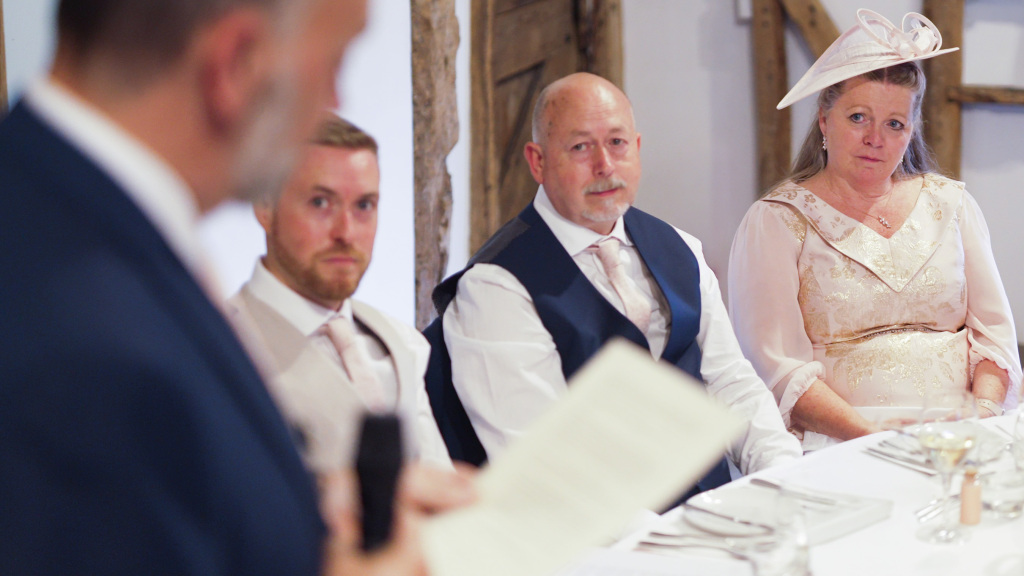
Emotional speech by the father of the bride at South Farm (Cambridgeshire) wedding
What If You Get Emotional?
This is worth addressing because it happens often, and it’s absolutely fine.
Weddings are emotional. If you feel yourself getting choked up during your speech, pause. Take a breath. Have a sip of water. Smile if you can. The room will wait – nobody minds. In fact, those moments often become some of the most treasured parts of the film because they’re so genuinely felt.
If you know there’s a particular section that might set you off, you can either prepare for it (slow down, breathe through it) or you can lean into it. Some of the most powerful speeches we’ve filmed have been the ones where the speaker got emotional and just let it happen naturally.
Remember, everyone in that room wants you to do well. They’re not judging you. They’re rooting for you.
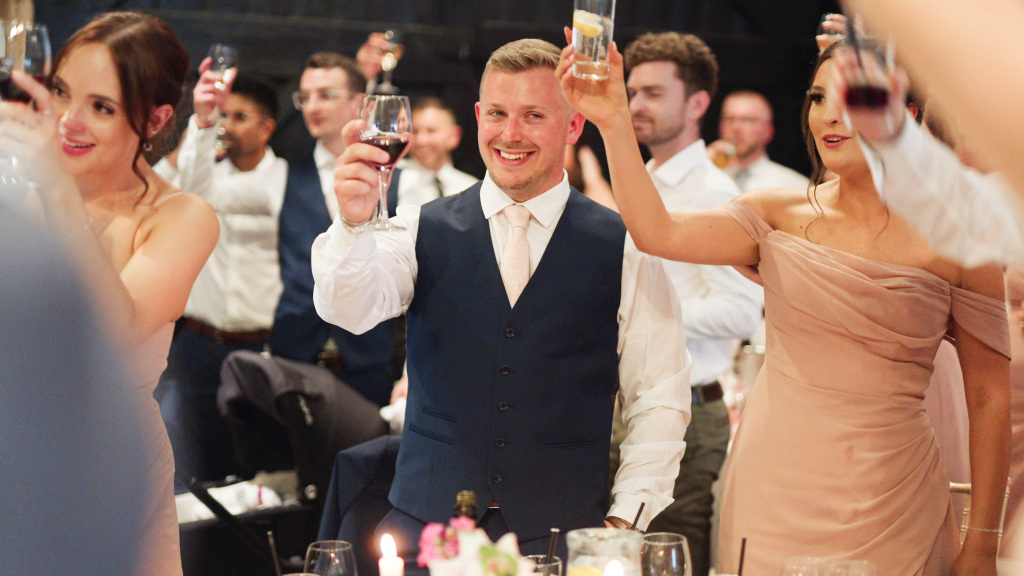
Wedding guests toast to the bride and groom during speeches at South Farm, Cambridgeshire
Movement During a Wedding Speech
Natural movement is absolutely fine. Pacing unpredictably, however, is harder to film cleanly.
If you intend to move around the room, turn frequently, or walk towards guests, mention this to your videographer beforehand. That small conversation allows camera operators to position themselves properly and avoid blocking anyone’s view.
If in doubt, stay grounded and let your words do the work. There’s no need to perform – just be yourself.
Don't Forget to Smile
This sounds obvious, but it’s easy to forget when you’re nervous or concentrating on what you’re saying next.
Smiling naturally, especially during the lighter, funnier moments of your speech, makes an enormous difference on camera. It helps you look relaxed and confident, and it gives the audience (and the couple watching back years later) permission to relax and enjoy the moment with you.
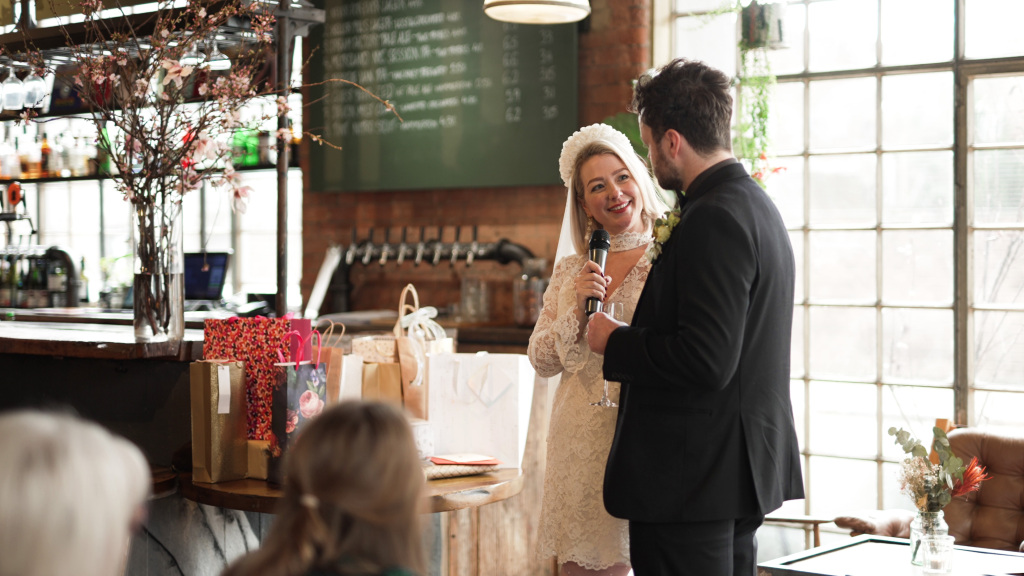
Newly wed couple deliver natural speech together in London
Keep It Concise
This isn’t strictly about writing advice, but delivery genuinely improves when speeches are focused.
As a general guide:
- 5 to 8 minutes feels strong and engaging
- Anything over 12 minutes often begins to lose the room
Shorter speeches maintain energy. They also make for a tighter, more impactful wedding film. Say what matters, say it well, and then sit down to applause. That’s the sweet spot.
A Final Thought
Here’s something to remember when you’re standing there with everyone looking at you and that camera quietly recording in the corner.
The lens isn’t there to judge you. It’s there to preserve something that matters: your voice, your words, your presence in this moment. Years from now, when the couple watch their wedding film, they won’t be analysing your phrasing or critiquing how you stood. They’ll be listening to hear you again. They’ll be watching to see the look on your face when you raised a glass to them. They’ll be reliving how the room felt when everyone laughed at that story only you could tell.
If you rehearse properly, stand in good light, hold your prompt cards low, and coordinate briefly with your videographer, you’re already ahead of most speakers. Deliver it calmly. Speak clearly. Look up often. Smile.
That’s genuinely more than enough.